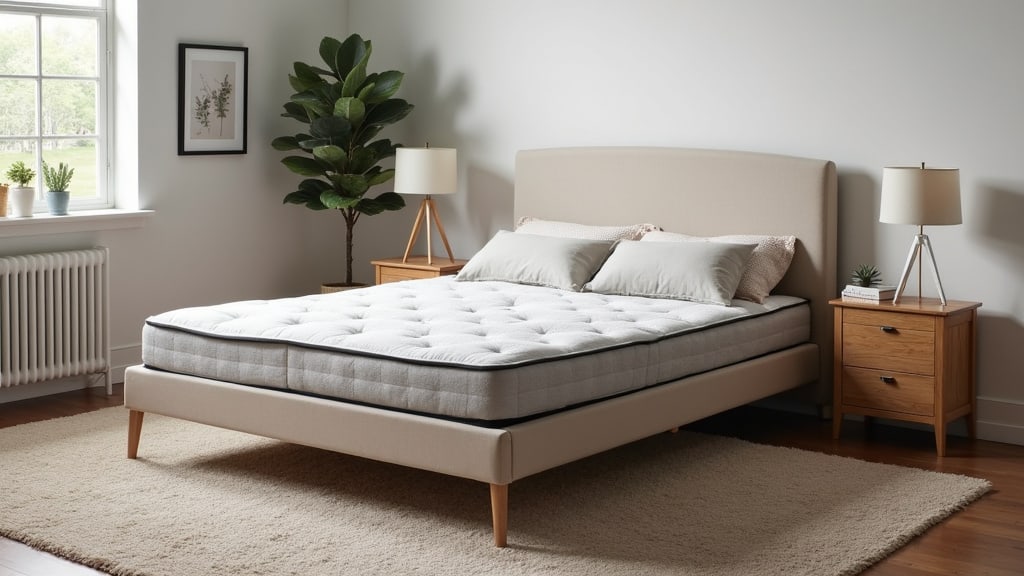
Bed Frame vs Mattress Foundation: Which Do You Need? (November 2026)
A bed frame supports the bed setup, while a mattress foundation supports the mattress. You may need just a frame, just a foundation for an existing base, or both, depending on the frame and your mattress maker's support requirements.
On this page (5 sections)
A bed frame holds and raises the bed setup; a mattress foundation supports the mattress. In the mattress foundation vs bed frame decision, you may need one or both, depending on whether your frame already has a supportive platform and what your mattress requires.
A platform bed frame can do both jobs. A basic frame with open rails or a perimeter may need a separate foundation between it and the mattress.
The terms can overlap, so start by checking what each part actually does. Our guide to what a bed base is and how the terms differ explains the common names.
Mattress foundation vs bed frame: what is the difference?
A frame supports the overall bed setup, while a foundation provides a surface for the mattress. A platform frame combines those roles; a simpler frame may need a foundation on top.
A bed frame usually holds the mattress support above the floor and may provide legs, a headboard connection or storage clearance. Its exact structure varies by style.
A foundation is the layer directly beneath the mattress. It may be a slatted platform, a rigid base or a box spring style support.
Some products are called foundations even though they use metal slats inside a covered structure. The name alone doesn't tell you whether you can put the unit directly on the floor or need a frame beneath it.
The difference between a box spring and a foundation matters because a box spring is one kind of support layer, while foundations can use other constructions.
Is a bed frame a foundation?
A platform bed frame can serve as the mattress foundation when its surface gives the mattress the support it requires. A basic frame without a platform generally needs a separate support layer.
Look for slats or a solid platform across the area where the mattress rests. Then check the mattress maker's instructions for slat spacing and any other support limits.
A metal perimeter frame alone may hold a foundation without supporting the mattress directly. If you're unsure what a frame type provides, compare different types of bed frames side by side.
What does a foundation add?
A foundation gives the mattress a consistent support surface and can add height. It may also help a basic bed frame support a mattress that shouldn't sit directly on open rails.
A 5-inch foundation can change the height of the finished bed, so count its height along with the frame and mattress. Consider how easily you can sit on the edge and get in and out.
The foundation's construction matters too. Confirm that it suits the mattress, fits the frame and can support the combined load.
Do you need a frame, a foundation or both?
You need a frame, foundation or combined platform that meets the mattress maker's support rules. The simplest setup is a platform frame that already meets them.
Use this checklist:
- Platform frame with compatible support: The frame may be all you need.
- Basic frame without mattress support: Add a compatible foundation.
- Foundation without a frame: Use it only on a surface and in a setup its instructions allow.
- Adjustable base: Follow the mattress and base makers' compatibility guidance.
Don't add a foundation automatically just because the mattress is new. If the frame already has a suitable platform, another layer may only raise the mattress without improving the support.
On the other hand, a frame that only holds the mattress around its edges may leave the center unsupported. Identify the frame's actual support surface before deciding.
If you're still comparing mattresses, this guide to how to mattress shop includes support compatibility as part of the choice. Mattress materials also affect which bases may work; what memory foam mattresses are made of is useful background when you review the maker's instructions.
Which mattress support works with your mattress?
Match the support surface to the mattress maker's instructions, since mattress types don't all use the same rules. For one common case, see whether hybrid mattresses need a box spring.
Check for a required foundation, platform, slat spacing or adjustable base compatibility.
A mattress may be described as suitable for a platform, but that doesn't answer every setup question. If yours is an innerspring, read whether it needs a box spring.
Confirm the allowed slat spacing, whether a solid surface is acceptable and whether the maker requires a specific foundation type.
For a hybrid mattress, use the maker's guidance before choosing a base. Our article on whether hybrid mattresses need a foundation covers the decision.
Foam mattresses also have specific support needs. See whether you need a box spring with a foam mattress before placing one on an older frame.
Can you use slats instead of a foundation?
Slats can replace a separate foundation when the mattress maker approves the frame and its slat spacing. Slats that are too far apart may fail to give the mattress the support it needs.
Measure the gaps between slats rather than judging them by appearance. Check that the slats stay in place under the mattress and that a center support is present when the frame design calls for one.
A platform frame with an approved slat layout can save a layer and keep the bed lower. A foundation can be simpler if the existing frame's support surface doesn't meet the mattress requirements.
What should you check before buying?
Check size, support, height and fit before choosing a frame or foundation. A unit can be the right type and still be the wrong size or raise the mattress too high.
Measure the mattress and frame, including interior dimensions where the foundation sits. A foundation that's too large may not fit; one that's too small may shift or leave an unsupported edge.
Count the finished height: frame or legs, foundation if used, and mattress. If the bed is near a window, headboard, nightstand or low ceiling, account for those points too.
Think about moving and storage. A folding frame may help through tight doorways, while a foundation may add a separate piece to carry and position.
For an existing frame, inspect its slats, rails and center supports before adding weight. Replace damaged components rather than covering them with another layer.
Which is easier to assemble?
Assembly depends on the exact frame or foundation, so compare the included setup method and the space you have to work in. Tool-free or interlocking designs can reduce the steps, but they still need to be assembled as directed.
The Amazon Basics Bed Frame with Storage uses a folding mechanism and tool-free setup. It is a queen metal platform frame, so it can support a mattress without a separate box spring.
The Amazon Basics Smart Box Spring Bed Base uses an interlocking, tool-free assembly and has horizontal metal slats. It works as a separate support layer when your frame needs a foundation.
The queen version of the Amazon Basics Smart Box Spring Bed Base has the same 5-inch height and interlocking setup. Choose it when the mattress and frame call for a queen foundation.
The HLIPHA Metal Platform Bed Frame 14 Inch has a slatted platform base and doesn't require a box spring. Its full-size platform design also leaves under-bed storage space.
Mattress foundation vs bed frame: which should you choose?
Choose a platform frame if it meets your mattress's support rules; choose a separate foundation if your frame needs a support surface. Use both when the frame and mattress setup calls for a separate layer.
If your current bed has a sturdy, compatible platform, keep the setup simple and place the mattress directly on it. If it has only rails or an unsuitable slat layout, add a foundation that fits and follows the mattress maker's requirements.
Before you buy, verify the mattress size, support instructions, frame dimensions and final bed height. Those checks will tell you whether you need a frame, foundation or both.
Frequently asked questions
Is a bed frame a foundation?
A bed frame is a foundation only when its design also supports the mattress, as a platform frame does. A basic frame may only hold a separate foundation, such as a box spring or rigid mattress base.
Check whether the frame has a supported platform or slats and whether their spacing suits your mattress.
Can you use a mattress foundation without a bed frame?
You can use a foundation on a suitable flat, level surface if its instructions allow it, but a foundation is often placed on a bed frame to raise the mattress and keep the setup stable. Check the foundation's requirements and leave room for ventilation and safe access.
Do all mattresses need a foundation?
No. Some mattresses can rest on a compatible platform bed or slatted frame, while others need a foundation or have specific support requirements.
Read the mattress maker's instructions for the required surface, slat spacing and any warranty conditions before assembling the bed.
Can you put a box spring on a platform bed?
You can place a box spring on a platform bed if the frame has enough room and its instructions permit the added height and weight. Most platform frames already provide mattress support, so adding a box spring may be unnecessary.
Check the mattress and frame requirements before combining them.