How to Choose Bed Risers with Outlets
Bed risers with outlets can add a nearby place to plug in devices while raising a bed, but check the outlet layout, cord route, bed-leg fit and support before choosing. A powered riser is useful only if its electrical features work with your room and bed.
On this page (8 sections)
- What should you check in bed risers with outlets?
- How do you check bed support compatibility?
- How high should the risers lift your bed?
- Will powered risers work with an adjustable bed?
- Which regular risers can help with height or storage?
- How do you install risers and route the cords?
- Are powered bed risers better than regular blocks?
- What should you do before using a new riser?
Bed risers with outlets can add power access beside a raised bed, but the outlet and cord setup must fit your room, and the riser must support your bed securely. Check the outlet features, cord path, riser height and the shape of your bed legs before you buy.
Some powered risers include outlets or USB ports, while basic risers only raise furniture. Decide whether you need charging access at the bed or only more clearance underneath.
If it’s mainly storage you want, compare best bed riser blocks as well.
What should you check in bed risers with outlets?
Start with the electrical layout and safe cord route. A built-in outlet helps only if it accepts the devices you use and the cord can reach the wall without creating a trip or pinch point.
Check each feature in the specifications and instructions:
- Outlet type: Confirm whether the riser has standard AC outlets, USB ports or both, and how many of each.
- Cord length: Measure from the riser’s planned position to the wall receptacle. Leave enough slack for the bed’s normal position without letting the cord cross a walkway.
- Switch and indicator: If the model has a switch or light, check where it sits and whether you can reach it from the bed.
- Power limits: Follow the manufacturer’s stated limits for connected devices. Don’t assume that multiple sockets can each handle a high-power appliance.
- Cord protection: Look for a route that keeps the cord away from bed legs, moving parts, sharp edges and places where it could be crushed.
A built-in outlet is not automatically a substitute for a bedside power strip. The model’s instructions determine which devices and loads are suitable.
Before setting up the bed, trace the cord from the riser to the wall. Keep it visible and loose enough to avoid tension, but secured away from where feet, drawers or a vacuum could catch it.
How do you check bed support compatibility?
Choose risers that fit the actual contact points under your bed. Measure each leg or caster at its base, then compare that shape and width with the riser opening and support surface.
A bed with four narrow posts has different needs from one with wide feet or wheels. The riser should hold each support point in place, with no edge that lets it slip off during ordinary movement.
Check these details before ordering:
- Measure the width and depth of each bed foot or post at the bottom.
- Note whether the frame has legs, a continuous base, or casters.
- Compare the measurements with the riser’s recess or opening.
- Confirm that all bed contact points sit level and at the same height.
- Check the manufacturer’s load guidance against the bed, mattress and occupants.
Don’t assume a high weight figure makes a riser compatible with every frame. Shape and contact area matter, too.
For a frame without separate legs, read how to choose bed risers for beds without legs. For caster bases, see how to choose bed risers for wheels.
How high should the risers lift your bed?
Pick a height that gives you the clearance you need without making the bed feel awkward to get into or out of. Measure the space beneath the bed now, then compare it with the height of the bins or items you want to store.
Include the riser’s added height when estimating the finished bed height. A taller bed may change how easily you reach the floor, nightstand or nearby outlet, so consider the whole setup rather than storage space alone.
Some risers offer one fixed height; adjustable or stackable designs provide more than one setup. For stackable options, follow the maker’s instructions and use only the combinations intended for that model.
Check that every riser sits flat and that the legs remain fully supported.
If you’re unsure about the height, start with the smallest lift that clears your storage. Raising a bed more than needed can make climbing in less comfortable and may leave a longer drop to the floor.
Will powered risers work with an adjustable bed?
Check the adjustable base’s movement and power setup before adding a riser. Moving parts and cords need clear space, and the base may have specific placement instructions that affect whether risers are suitable.
Read the base manual for its support points, leg setup and required clearance. Confirm that a riser won’t block the base’s movement, strain its power cord or interfere with controls.
Don’t lift an adjustable base at a point its manufacturer does not approve.
If you need a control for an adjustable base, an outlet riser may not solve that problem. See our guide to best adjustable base remote replacement for remote options.
Which regular risers can help with height or storage?
Regular risers can suit beds where clearance and stable support matter more than built-in power. If your mattress needs a separate foundation, compare full-size metal box springs.
For a wood option, see full-size wood box springs. These options don’t have outlet features, so consider them if you can meet your power needs another way.
HOME IT 5 to 6-inch Black Bed
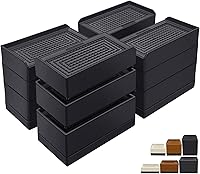
This fixed-height set is for buyers who want extra clearance below furniture with supported feet or casters. The recessed top has a 1 in lip, and the risers raise furniture 5.25 in.
The four-pack is made of plastic and has a stated maximum weight recommendation of 300 lb. Check that the combined load and the riser opening suit your bed before choosing it.
Home It Adjustable Bed Risers
This set includes four 3 in risers and four 5 in risers that can be stacked for a combined height of up to 8 in. It offers more height choices than a single-height set.
The risers are polypropylene, and the manufacturer describes total support of up to 1,300 lb. Confirm the bed-leg fit and follow the setup instructions for the height you choose.
MYMULIKE Bed Risers 3 Inch
This set suits furniture with larger contact points: its top opening is 5.5 x 5.5 in and 0.7 in deep. Measure the bed feet carefully, since an oversized opening may not secure narrow legs as well as a close-fitting recess.
The four risers are made of ABS and are designed to stack. Check the maker’s guidance for compatible furniture and load limits rather than relying on a large per-leg figure without confirming fit.
How do you install risers and route the cords?
Install risers on a level, stable floor, then confirm that every bed support is fully seated. For powered risers, route the cord after the bed is in its final position, keeping it clear of moving parts and pressure points.
Follow the model’s instructions. In general, remove weight from the frame as directed, place one riser under each approved support point, and lower the bed so each leg sits securely in its recess.
Don’t improvise by stacking pieces the manufacturer doesn’t say can be stacked.
Once the bed is back in place, check that it doesn’t rock and that every support remains centered. Test the bed’s normal movement gently before using it.
If any riser shifts, remove the load and correct the fit.
For a step-by-step setup overview, read how to use bed risers. If your bed is a Twin XL, our guide to best bed risers for Twin XL dorm beds covers that bed size.
Are powered bed risers better than regular blocks?
Powered risers make sense when you need an outlet at the bed and can route the cord safely. Regular blocks are simpler when you only want clearance, storage space or a change in bed height.
Compare the two types against your actual needs:
| Need | Powered risers | Regular risers |
|---|---|---|
| Plug access beside the bed | Built-in outlets or ports, depending on the model | Requires a separate power solution |
| Cord management | Must plan the riser cord’s path | No built-in electrical cord |
| Height and support | Varies by model | Varies by model |
| Bed-leg fit | Must match the riser opening | Must match the riser opening |
| Main reason to choose | Convenient access to compatible devices | Extra clearance without added electrical features |
The presence of an outlet doesn’t tell you whether a riser will fit a bed frame. Check the opening, support surface and load guidance for both powered and regular designs.
For a low-profile board option, compare bunkie boards with holes.
If your frame choice is still open, our how to choose a bed frame without regrets guide can help you think through support and fit before buying. If your setup includes a headboard, see box spring setups with headboards.
What should you do before using a new riser?
Check the installation and all support points before putting the bed back into everyday use. If the riser shifts, cracks or leaves a leg partly unsupported, stop and reassess the fit.
Use this final checklist:
- Confirm every leg, post or caster is centered and seated.
- Check that the bed is level and does not rock.
- Keep the riser’s power cord away from pinch points and walking paths.
- Plug in only devices that meet the manufacturer’s stated limits.
- Recheck the setup if you move the bed or change the riser height.
Choose a powered model when its outlet features and cord route suit your room. Choose regular risers when you mainly need height or storage, and compare fit and support before settling on a design.
For a frame built around a metal platform base, see best Zinus SmartBase mattress foundation.
Frequently asked questions
Do bed risers with outlets need to be plugged into a wall?
Powered bed risers need a power source for their outlet features. Check the cord length, plug type and required wall connection for the exact model, then make sure the cord can reach without crossing a walking path or being pinched under furniture.
Can I use bed risers with any bed frame?
No. The riser opening must match the bed's feet, posts or casters, and the frame must transfer its weight securely to those contact points.
Measure the base of each leg and check the riser's shape and load guidance before using it.
Are bed risers with outlets safe?
They can be suitable when installed and used as directed, but safety depends on the specific electrical design, load, cord routing and bed fit. Follow the manufacturer's instructions, keep cords clear of pinch points, and stop using a riser if it becomes damaged or unstable.
Can I use regular bed risers instead of powered ones?
Yes, regular risers can provide extra clearance without built-in outlets. Choose them if your main goal is under-bed storage or height, and use a separate, properly rated outlet solution if you also need charging or power near the bed.
What should I check before buying bed risers with outlets?
Check the outlet type and number, cord length, any switch or USB features, riser height, leg opening, material, load guidance and return terms. Measure the bed legs and the route to a wall outlet, then confirm that the risers suit your frame and room.